
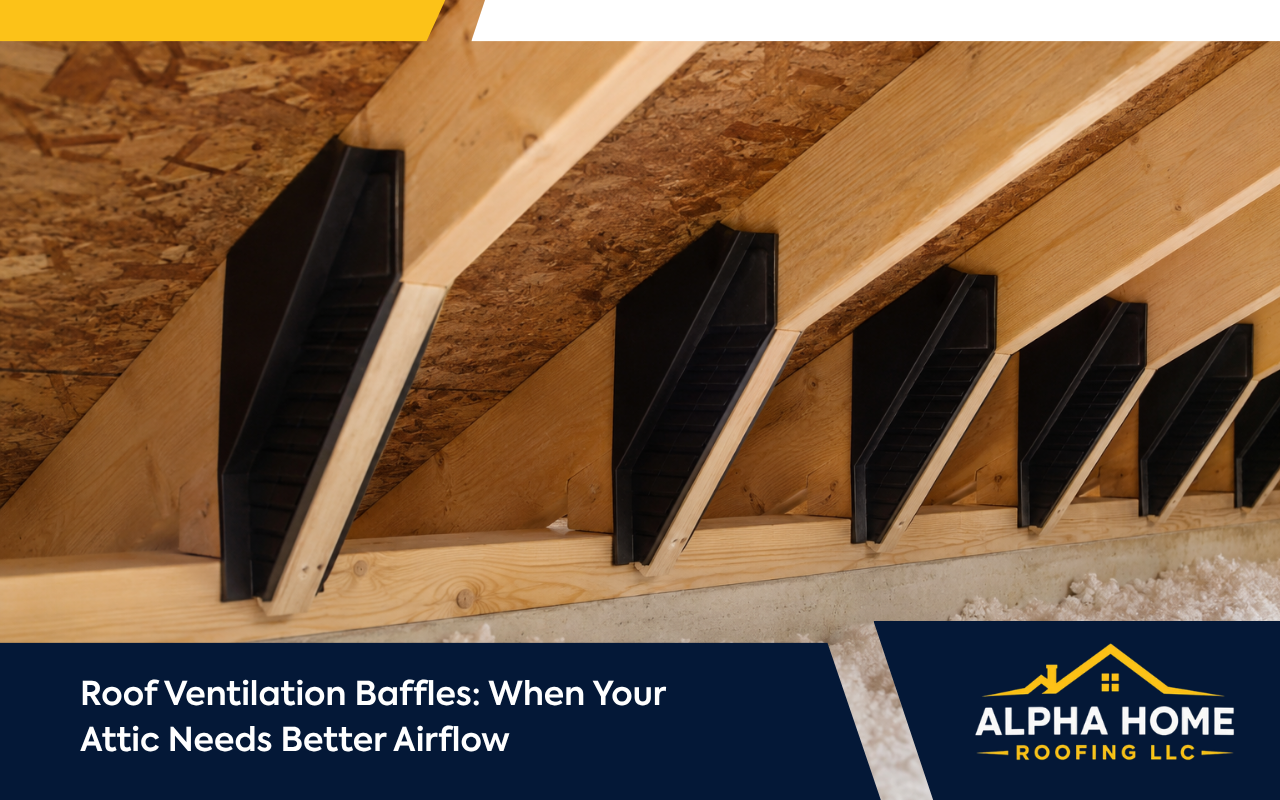
A healthy attic needs clear paths for air to enter, move, and leave. Roof ventilation baffles protect those paths by keeping insulation away from soffit vents and guiding fresh air toward higher roof vents.
At Alpha Home Roofing LLC, we help homeowners understand how attic airflow supports roof performance and indoor comfort. Our guide to roof ventilation in New Jersey explains how the main parts of a balanced system work together.
Understand How Baffles Keep Attic Air Moving
Roof ventilation baffles are panels installed between roof rafters near the eaves. They create a protected channel between the roof deck and attic insulation.
This channel allows outdoor air to enter through soffit vents without being blocked. As warmer air rises, it moves toward ridge vents or other exhaust vents near the top of the roof.
The baffles support this natural movement by keeping the lower intake area open. Clear airflow can help reduce trapped heat and indoor moisture in the attic.
These panels may also be called attic airflow baffles. They are commonly made from plastic, foam, or treated fiber materials. Their main purpose remains the same: protect the airflow path from the eaves into the attic.
Protect Roof Vent Channels and Insulation Clearance
Roof vent channels need enough open space to move air without resistance. Insulation should cover the attic floor, but it should not fill the space directly below the roof deck or block soffit openings.
Baffle Clearance Checklist
- Baffles should begin above each active soffit vent.
- The channel should remain open between the insulation and roof deck.
- Insulation should fit around the baffle without crushing it.
- The lower edge should help prevent loose insulation from entering the soffit.
- Each channel should connect with the larger attic space.
Correct clearance protects both ventilation and insulation performance. When insulation blocks the intake area, the attic ventilation system may not receive enough fresh air.
This can create uneven temperatures and damp areas near the roof deck.
Key Takeaway
Baffles help protect intake airflow. They work best when soffit vents, roof vent channels, insulation clearance, and exhaust vents support the same airflow path.
Compare Baffle Problems With the Right Fix
Attic ventilation problems can come from blocked soffits, compressed baffles, loose insulation, limited exhaust, or moisture entry. A simple comparison can help homeowners understand when an inspection makes sense.
Roof Ventilation Baffle Guide
| Problem | Why It Matters | Helpful Next Step |
|---|---|---|
| Insulation blocks soffit vents | Fresh air cannot enter the attic properly. | Add or adjust baffles to protect intake airflow. |
| Baffles are bent or crushed | The channel may not move air as intended. | Replace damaged panels and check insulation placement. |
| Dark or damp roof sheathing | Moisture may be collecting near the roof deck. | Review ventilation balance and possible air leaks. |
| Only some rafter bays have airflow | Ventilation may be uneven across the attic. | Check active soffit vents and channel placement. |
| Exhaust vents are limited | Intake air may not move through the attic effectively. | Review the full attic ventilation system. |
Support Moisture Control Through Balanced Ventilation
Daily activities such as cooking, bathing, and washing clothes add moisture to indoor air. Some of this warm air can rise into the attic through small gaps around lights, pipes, and access doors.
When warm moisture touches a cold roof surface, condensation may form. Over time, repeated dampness can affect insulation, wood, and other attic materials.
Our team focuses on both airflow and possible moisture entry points when reviewing attic conditions. Baffles support moisture control, but they are only one part of the solution.
Intake vents, exhaust vents, insulation, and air sealing must work together. Homeowners who notice damp sheathing or wet insulation can review our attic condensation solutions for more guidance.
Key Takeaway
Baffles can support moisture control, but they cannot fix every condensation problem. Air sealing, exhaust ventilation, insulation, and intake airflow should be reviewed together.
Avoid Common Baffle Installation Problems
Roof ventilation baffles must remain open after installation. A panel that bends, tears, or becomes packed with insulation cannot guide air as intended.
Careful placement helps protect the channel over time. Another mistake is adding intake ventilation without enough exhaust space.
Installation Mistakes to Avoid
- Do not compress the panel with tight fasteners.
- Do not leave gaps above active soffit vents.
- Do not cover intake openings with loose insulation.
- Do not assume every rafter bay has an active vent.
- Do not ignore damaged or disconnected panels.
Limited exhaust can reduce air movement through the roof vent channels. Ventilation balance should be reviewed before adding or changing attic components.
Schedule Seasonal Checks for Clear Attic Airflow
Attic conditions can change as insulation shifts, pests enter, or roof work is completed. A simple visual review can reveal blocked channels, loose panels, water stains, or damp insulation before the problem becomes harder to manage.
Seasonal Attic Airflow Checks
- Check soffit areas for insulation or debris.
- Look for baffles that have fallen or bent.
- Inspect the roof deck for dark or damp areas.
- Confirm that exhaust vents remain clear.
- Review attic conditions after major storms or roof repairs.
With Alpha Home Roofing LLC, you can connect attic observations with the condition of the full roofing system. Our seasonal roof care guidance can help you plan practical checks throughout the year.
Key Takeaway
Attic airflow can change over time. Seasonal checks can reveal blocked soffits, shifted insulation, loose baffles, moisture stains, or damaged ventilation parts.
Decide if Baffles Are Right for Your Attic
Baffles are useful when soffit vents supply intake air and insulation may block the space near the eaves. They can also help during insulation upgrades because they mark the area that must remain open.
However, baffles cannot fix every ventilation problem. An attic may also have limited exhaust ventilation, blocked soffits, air leaks, or moisture entering from another source.
The full attic ventilation system should be considered before choosing a solution. A professional review may be helpful when the attic has visible moisture, repeated ice buildup, damaged insulation, or uneven temperatures.
When you choose a roofing company in Elizabeth, NJ, ask how intake, exhaust, insulation, and air sealing will be evaluated together.
Frequently Asked Questions
What do roof ventilation baffles do?
They create a clear path for air between soffit vents and the attic. This path keeps insulation from blocking intake airflow. More details are available in our roof ventilation guide.
Can baffles help reduce attic condensation?
They can support moisture control by improving airflow, but they may not solve air leaks or other moisture sources. At Alpha Home Roofing LLC, we consider ventilation balance and attic conditions together. Review our attic condensation information for related steps.
Should every rafter space have a baffle?
Not always. Placement depends on the number and location of active soffit vents. The goal is to protect each needed intake path without adding panels where they provide no airflow benefit.
How often should attic baffles be inspected?
A visual check during seasonal roof care or after attic work is practical. Look for loose panels, blocked channels, and moisture signs. Our seasonal roof inspection plan offers useful reminders.
Can homeowners install attic airflow baffles themselves?
Some homeowners can install them in easy-to-reach areas, but attic access and fastening may be difficult. Professional support is sensible when space is limited, wiring is nearby, or moisture damage is visible.
Build a Better Plan for Attic Airflow
Roof ventilation baffles can protect intake airflow, preserve insulation clearance, and support a more balanced attic. Their value depends on correct placement and clear roof vent channels from the eaves into the attic.
At Alpha Home Roofing LLC, we can review how your ventilation parts work together and identify areas that may need attention. To discuss attic airflow with a roofing company in Elizabeth, NJ, visit our contact page for attic ventilation support.